
When hospital owners compare Traditional vs Digital Healthcare Marketing, the discussion often gets stuck on cost and trends. But in healthcare, marketing is not about chasing the cheapest option or the newest channel. It’s about visibility, trust, and choosing the right approach at the right stage of growth. This article breaks down traditional and digital healthcare marketing using real examples, real numbers, and practical decision logic—so you can invest with clarity, not guesswork.
1. What Healthcare Marketing Is Actually Meant to Do
Before comparing traditional marketing and digital marketing, one thing has to be clear.
Healthcare marketing has only two real jobs.
First: make people aware that you exist.
This is visibility. Branding. Recall.
Second: bring patients through the door.
These are leads, appointments, walk-ins.
Everything else is secondary.
Here’s the important part most hospital owners miss.
Healthcare marketing is not impulse marketing.
People don’t choose a hospital the way they choose a shoe or a phone.
Offers like “25 tests for ₹500” may bring short-term traffic, but they don’t build long-term trust.
What actually builds trust is consistent visibility over time.
- Seeing your hospital name repeatedly
- Hearing about you from different places
- Finding you when they search
- Feeling that you are established and reliable
That’s why comparing marketing channels only on cost is misleading.
The real comparison is:
- How well does this channel build visibility?
- How much trust does it create before the first visit?
- Can it consistently bring patients, not just one-time spikes?
Before comparing traditional marketing with digital marketing, we need to get clear on three basic terms.
Otherwise, every comparison becomes vague and misleading.
The Three Terms You Must Understand
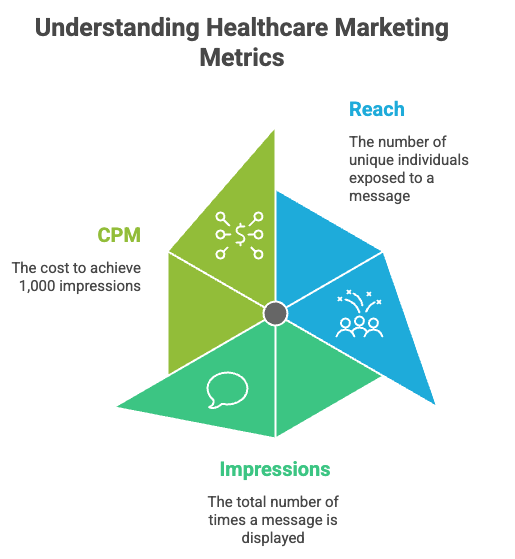
Reach
Reach is the number of unique people who could potentially see your message.
Example:
If 30,000 different people pass through an area in a month, your maximum reach is 30,000.
Impressions
Impressions are the number of times your message is shown or exposed.
One person can generate multiple impressions.
But in most traditional healthcare marketing, impressions are assumed, not tracked.
CPM (Cost Per Mille)
CPM means cost per 1,000 impressions.
2. Traditional Marketing in Practice (With Terms That Actually Matter)
Reach, Impressions and CPM are the only fair way to compare:
- Billboards
- FM radio
- Pamphlets
- Digital ads
Without CPM, you’re guessing.
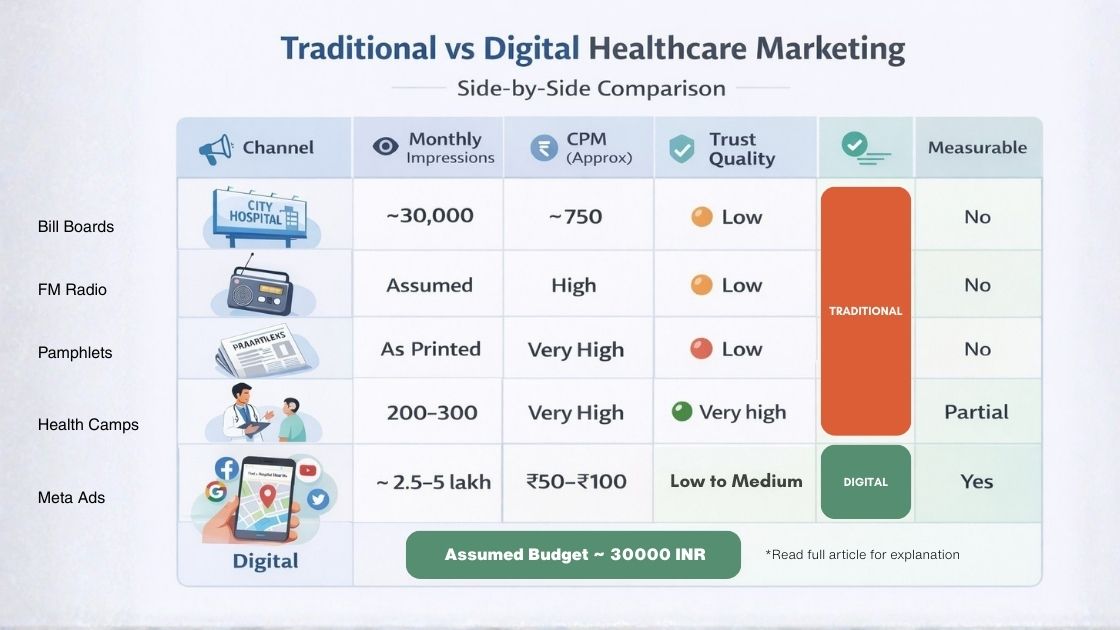
Example 1: Billboard Near a High-Footfall Area
Let’s take a realistic example.
- Daily footfall near a place like DMart (it’s a super market if you don’t know) : ~1,500 people
- Monthly footfall:
1,500 × 30 = 45,000 people
Not everyone notices a billboard.
Let’s assume:
- 70% notice rate
So:
- Monthly impressions ≈ 35,000
Now the cost.
- Billboard cost: ₹25,000 per month
CPM calculation
- 35,000 impressions ≈ 35 units of 1,000
- ₹25,000 ÷ 35 ≈ ₹740 CPM
That’s the real cost of visibility for that board.
No leads.
No tracking.
Just presence.
Example 2: FM Radio Advertising
FM radio works on repetition.
- Cost per second: ₹5–₹10
- 20-second ad ≈ ₹200 per play
If you play it:
- 5 times a day
Cost:
- ₹200 × 5 = ₹1,000 per day
- Monthly cost ≈ ₹30,000
The reach depends entirely on:
- Listener base of that FM station
- Time slot (morning and evening cost more)
Problems:
- You don’t know who listened
- You don’t know who remembered
- You don’t know who acted
Impressions are estimated.
CPM is assumed.
Outcomes are unknown.
Example 3: Pamphlet / Newspaper Insert Marketing
This looks cheap on the surface.
- Cost per pamphlet: ₹0.50
- 5,000 pamphlets = ₹2,500
- 50,000 pamphlets = ₹25,000
Add distribution:
- ₹500–₹1,000 per cycle
But here’s the issue:
- No guarantee the pamphlet is read
- No guarantee it’s remembered
- No way to measure impressions
You paid for printing and distribution.
Attention is optional.
Example 4: Health Camps (A Different Category)
Health camps don’t compete on reach.
They compete on trust quality.
- Attendance: 200–300 people
- Cost: ~₹15,000 per camp
Reach is low.
Impressions are limited.
But:
- Patients see you
- Talk to you
- Get examined by you
Trust per person is extremely high.
Health camps are deep, not wide.
3. Digital Marketing in Practice (With Real Numbers)
Digital marketing in healthcare usually looks complex from the outside, but in practice, most visibility campaigns boil down to one thing: CPM-based reach.
You’re paying to be shown to people who are already online.
The Basic Assumption Digital Marketing Works On
For digital marketing to work:
- The person must have a smartphone
- The person must be on the platform you’re advertising on
In most Indian cities today:
- Google and YouTube usage is almost universal
- Facebook and Instagram usage is very high
- Even Tier 3 cities often have ~70% internet penetration
That alone changes the scale of what’s possible.
Example: Digital Visibility Campaign (₹25,000 Budget)
Let’s take the same monthly budget used in traditional examples.
Budget
- ₹25,000 per month
Scenario 1: CPM = ₹50
- ₹25,000 ÷ ₹50 = 500
- Total impressions = 5,00,000 per month
Scenario 2: CPM = ₹100
- ₹25,000 ÷ ₹100 = 250
- Total impressions = 2,50,000 per month
Even at a higher CPM, the visibility is multiple times higher than:
- Billboards
- FM radio
- Pamphlets
And this is not assumed visibility.
These impressions are tracked.
Reach in a Real City Context
Take a city with:
- Population: 10 lakh
With ~70% internet penetration:
- Digitally reachable audience ≈ 7 lakh people
That reach:
- Is not limited to one road
- Is not tied to one time slot
- Is not dependent on physical presence
Your hospital can be visible:
- At home
- At work
- During search
- During video consumption
What Makes Digital Different From Traditional
Digital marketing allows:
- Controlled budgets
- Adjustable targeting
- Real-time data
You can see:
- How many people saw the ad
- How often it was shown
- Which creatives performed better
This feedback loop simply does not exist in traditional marketing.
The Catch (And It’s Important)
Digital marketing is not plug-and-play.
- It needs expertise
- Either you learn the basics
- Or you work with a competent digital agency
Bad digital marketing doesn’t just waste money.
It can damage perception.
That’s why digital looks powerful on paper, but only works in reality when executed properly.
We have written a comprehensive guide on digital marketing for doctors, do check it out.
4. Traditional vs Digital Healthcare Marketing: Where Each One Actually Wins
At this point, it’s clear that traditional and digital marketing are not competing on the same axis.
They win in different ways.
Digital Marketing Wins on Quantity
Digital marketing is built for scale.
- Hundreds of thousands of impressions
- Wide geographic coverage
- Continuous visibility
With the same budget:
- Digital reaches more people
- Reaches them more often
- Reaches them where they already spend time
This makes digital unbeatable for:
- New hospitals
- Low visibility brands
- Early-stage growth
If people can’t find you, nothing else matters.
Traditional Marketing Wins on Quality (In Specific Formats)
Most traditional formats are weak on trust.
But health camps are the exception.
In a health camp:
- Patients meet you
- Talk to you
- Get examined by you
The trust created per person is extremely high.
One good interaction can convert into:
- Repeat visits
- Word-of-mouth referrals
- Long-term loyalty
This level of trust cannot be achieved through ads alone.
Why Billboards and FM Sit in the Middle
Billboards and FM don’t win strongly on either side.
- They don’t reach at digital scale
- They don’t build trust like health camps
Their role is:
- Familiarity
- Local recall
- “I’ve heard this name before”
They support perception.
They rarely drive decisions on their own.
The Real Trade-Off Hospital Owners Must Accept
You are always choosing between:
- Breadth (how many people know you exist)
- Depth (how strongly a person trusts you)
Digital gives you breadth.
Health camps give you depth.
Trying to get both from one channel leads to disappointment.
The Smart Way to Think About This
- Use digital marketing to make sure people know you exist
- Use high-trust formats to convert awareness into belief
Quantity fills the funnel.
Quality closes it.
That’s the logic.
Next, we’ll talk about effort, skill, and cost realities, which is where many hospital owners misjudge things.
5. Skill, Cost, and Effort: The Part Most Comparisons Ignore
On paper, marketing channels are compared by cost and reach.
In reality, they should be compared by effort, skill, and risk.
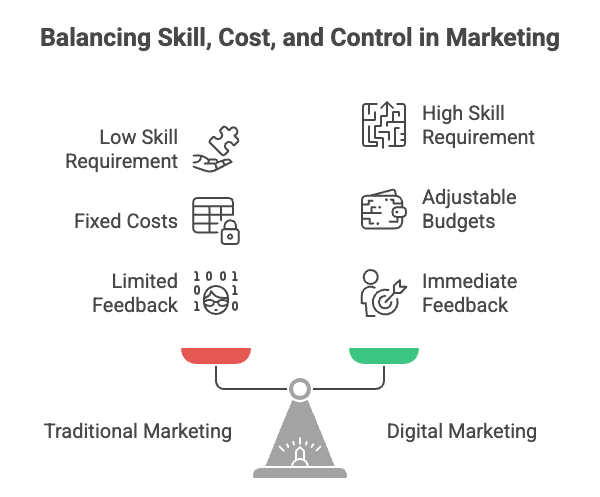
Traditional Marketing: Low Skill, High Blind Spend
Traditional marketing feels easier because:
- It’s familiar
- Agencies handle most execution
- There’s very little technical learning involved
You mostly:
- Approve creatives
- Pay for placements
- Wait
The downside:
- You keep spending
- Without knowing what’s working
- Or how to improve it
The risk is not complexity.
The risk is overspending without feedback.
Digital Marketing: High Skill, High Control
Digital marketing flips the equation.
It gives:
- Budget control
- Targeting control
- Performance data
But it demands:
- Strategy
- Execution skill
- Ongoing monitoring
Mistakes show up immediately:
- Poor targeting burns money
- Weak creatives reduce credibility
- Inconsistent execution kills results
Digital doesn’t forgive laziness.
Agency Dependence Exists on Both Sides
This is often overlooked.
- Billboards, FM, print → you still depend on agencies
- Digital → you depend on agencies or internal skill
The difference is:
- Traditional agencies give execution, not insight
- Good digital agencies give execution and learning
One helps you spend.
The other helps you decide.
Cost Predictability vs Cost Control
Traditional marketing:
- Fixed costs
- Long lock-ins
- Limited flexibility
Digital marketing:
- Adjustable budgets
- Pause, scale, or redirect anytime
- Faster course correction
This matters a lot when budgets are tight.
The Real Question Owners Should Ask
Not:
“Which is cheaper?”
But:
- Where do I have visibility gaps?
- Where am I wasting money without feedback?
- Where can I learn and improve month by month?
Marketing is not an expense.
It’s a system.
Next, we’ll talk about how this choice changes at different stages of hospital growth, which is where most owners get clarity.
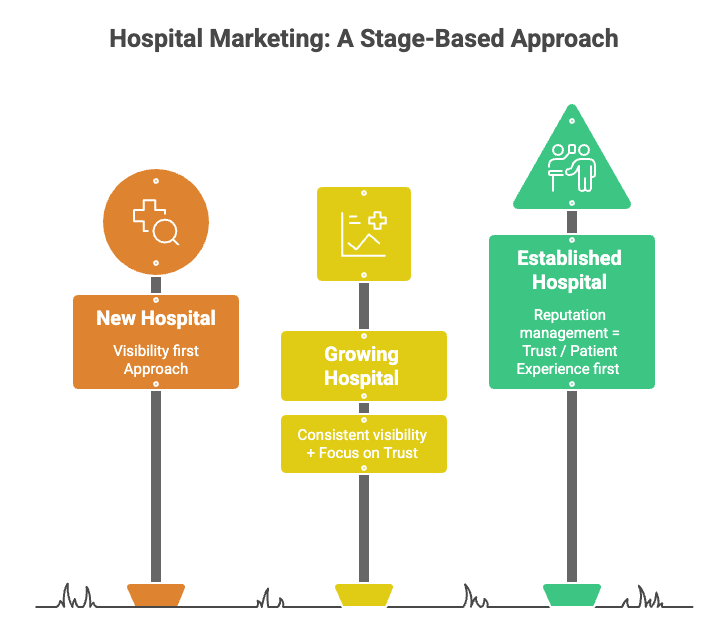
6. Marketing by Hospital Growth Stage
The biggest mistake hospitals make is using the same marketing mix at every stage.
What works for an established hospital will fail for a new one.
What works for a new hospital is inefficient for a mature one.
Marketing has to change as you grow.
Stage 1: New or Low-Visibility Hospital
Problem:
- People don’t know you exist
Priority:
- Visibility
At this stage:
- Health camps are premature
- Billboards are expensive
- FM and print are hard to justify
Digital marketing makes the most sense because:
- Budgets are limited
- Reach is high
- Visibility builds fast
Goal:
- Be discoverable on Google
- Be visible where patients already are
- Build basic recall
Stage 2: Growing Hospital
Problem:
- Some awareness exists
- Conversions are inconsistent
Priority:
- Visibility + credibility
At this stage:
- Digital continues to drive reach
- Profiles, reviews, and content start to matter
- Small, focused health camps start working well
Goal:
- Reinforce trust
- Improve conversion from awareness to visits
Stage 3: Established Hospital or Doctor
Problem:
- Awareness is already high
- Growth depends on trust and reputation
Priority:
- Deepening relationships
At this stage:
- Health camps work very well
- Word-of-mouth accelerates
- Digital shifts from visibility to reputation management
Goal:
- Stay top-of-mind
- Convert familiarity into loyalty
The Pattern Is Simple
- Early stage → visibility first
- Mid stage → visibility + trust
- Mature stage → trust first
Marketing is not about choosing channels.
It’s about choosing the right channel at the right time.
Next, we’ll tie everything together and explain why omnichannel works, but why digital usually comes first.
Conclusion: How Hospital Owners Should Actually Think About Traditional vs Digital Marketing Channels
Traditional marketing and digital marketing are not competing with each other.
They solve different problems at different stages.
Digital marketing creates discoverability.
It answers one critical question:
Can a patient find you when they need care?
Traditional marketing reinforces presence.
It tells the patient:
I’ve seen this hospital before. It feels established.
Health camps sit in a different category altogether.
They don’t scale, but they create real trust because patients meet the doctor directly.
This is why an omnichannel approach works — when done in the right order.
Most hospitals make the mistake of doing everything at once with limited budgets.
That usually leads to shallow visibility everywhere and impact nowhere.
A better mental model is this:
- If patients can’t find you, you have a visibility problem → digital comes first
- If patients find you but don’t trust you, you have a credibility problem → profiles, reviews, camps matter
- If patients know you but don’t act, you have a conversion problem → messaging and experience need work
Early on, budgets are tight and visibility gaps are large.
That’s why digital marketing usually makes the most sense at the start.
As awareness builds:
- Traditional formats reinforce recall
- Health camps convert familiarity into belief
The strongest hospitals don’t pick sides.
They sequence their marketing based on growth stage.
Visibility first.
Trust next.
Channels evolve as the hospital grows.
Pingback: How to Choose Right Digital Marketing Agency for Healthcare?