
Wanna learn what digital marketing for doctors means, how patients choose doctors online now a days and how ethical digital presence helps the right patients find your clinic?
Let’s get started.
Table of Contents
Section 1: Why “Digital Marketing” Even Matters for Doctors
Let’s start with a simple truth.
Patients don’t choose a doctor the way they used to.
Earlier, the journey was short.
Someone in the family knew a doctor. A local chemist suggested a name. A senior doctor referred a case. That was enough.
Today, even when a referral exists, patients still search.
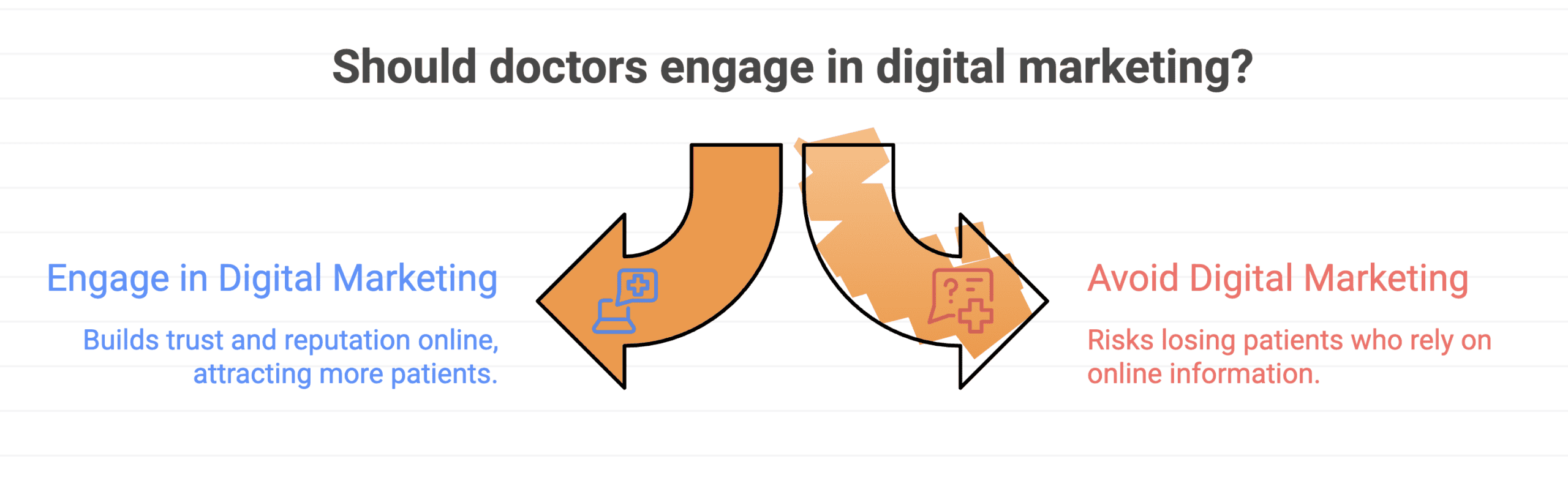
They Google symptoms.
They look up the doctor’s name.
They check the clinic location, timings, photos, and reviews.
Sometimes they do all this quietly before ever calling you.
This doesn’t mean patients trust Google more than doctors.
It means Google has become the first checkpoint, not the final decision.
What this really means is simple:
Your reputation is now partly shaped outside your clinic, whether you participate or not.
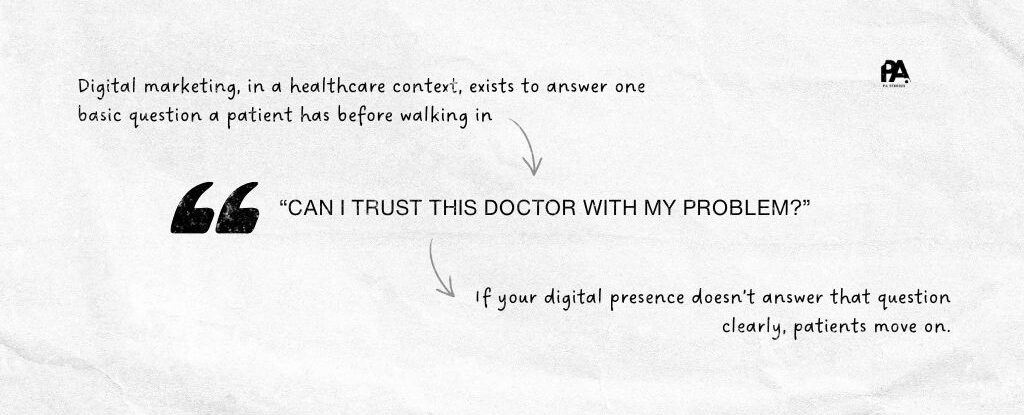
Digital marketing, in a healthcare context, exists to answer one basic question a patient has before walking in:
“Can I trust this doctor with my problem?”
If your digital presence doesn’t answer that question clearly, patients move on. Not because you aren’t competent, but because they couldn’t find reassurance fast enough.
This article isn’t about selling, advertising tricks, or aggressive promotion.
It’s about understanding how patient behavior has changed and how doctors can respond ethically, calmly, and intelligently.
Section 2: What Is Digital Marketing for Doctors?
Digital marketing for doctors is often misunderstood, so let’s strip it down to basics.
It is not about running ads all the time.
It is not about dancing reels or viral content.
It is not about competing with other doctors online.
At its core, digital marketing for doctors means:
Making accurate, trustworthy information about you and your practice easily available where patients already look.
That’s it.
In healthcare, digital marketing has a different responsibility compared to other industries.
A restaurant can exaggerate. A doctor cannot.
A product can use urgency. Healthcare should not.
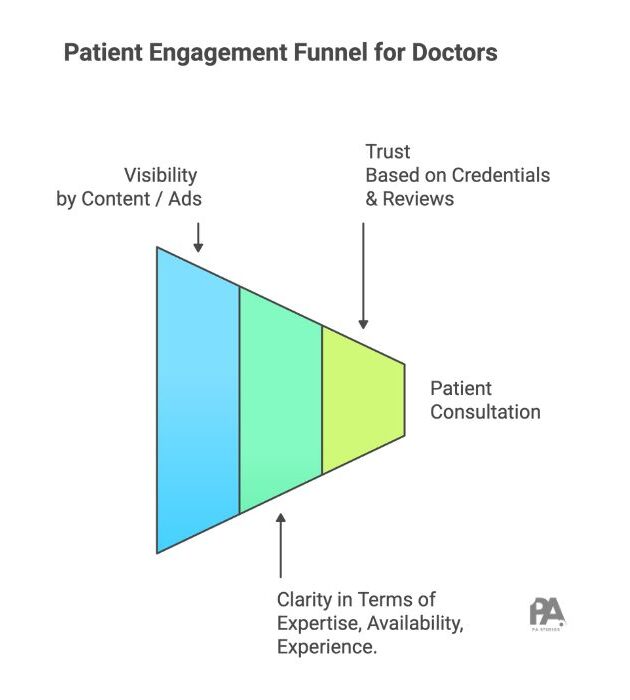
So digital marketing for doctors focuses on three things:
1. Visibility
Helping patients find you when they search for:
- A doctor near them
- A specialist for their condition
- A clinic they’ve been referred to
If you don’t appear clearly, patients assume you’re either unavailable or not relevant to their search.
2. Clarity
Answering basic patient questions before they visit:
- What do you treat?
- Where is your clinic?
- Are you experienced?
- Do other patients trust you?
This reduces anxiety even before the first consultation.
3. Trust
Trust is built digitally through:
- Clear explanations
- Honest content
- Genuine reviews
- Consistent presence
This doesn’t replace your clinical skill.
It simply ensures patients reach you in the first place.
There’s also an important distinction here.
General digital marketing is designed to attract attention.
Healthcare digital marketing is designed to reduce uncertainty.
Doctors don’t need attention.
Patients need confidence.
That’s the lens through which everything else in this article will be explained.
Good. This is the section where most doctors have a quiet “oh… that’s what’s happening” moment.
Section 3: How Patients Actually Choose a Doctor Today
Patients don’t sit down one day and decide to “do digital research.”
They act out of anxiety.
A symptom appears.
A test report looks abnormal.
Pain doesn’t settle.
Someone in the family pushes them to check.
That’s when the phone comes out.
About 54.8% of patients use online searches specifically to decide if they even need professional help or if the symptom can be managed at home.
Step 1: The Symptom Search (Not the Doctor Search)
Most patient journeys begin with searches like:
- “Chest pain on left side”
- “Ear ringing causes”
- “Knee pain while climbing stairs”
- “Is this serious?”
At this stage, patients aren’t choosing you.
They’re trying to understand whether they should worry.
Doctors who publish clear, simple educational content often enter the patient’s world right here, without selling anything.
Step 2: “Doctor Near Me” Becomes the Filter
Once the patient decides they need a doctor, the search changes:
- “ENT doctor near me”
- “Best cardiologist in Hyderabad”
- “Orthopedic clinic Bengaluru”
This is where Google Search and Google Maps quietly decide who gets seen.
Patients look at:
- Distance and location
- Clinic timings
- Photos of the clinic
- Ratings and reviews
They rarely scroll endlessly. They shortlist fast.
If your information is incomplete, outdated, or missing, you’re filtered out without knowing it happened.
Step 3: The Name Check (Even With Referrals)
This part surprises many doctors.
Even when a patient is referred by:
- Another doctor
- A family friend
- A hospital
They still search your name.
They want reassurance:
- “Is this the same doctor?”
- “What kind of cases do they handle?”
- “Do others trust them?”
No content doesn’t mean neutrality.
It often signals uncertainty.
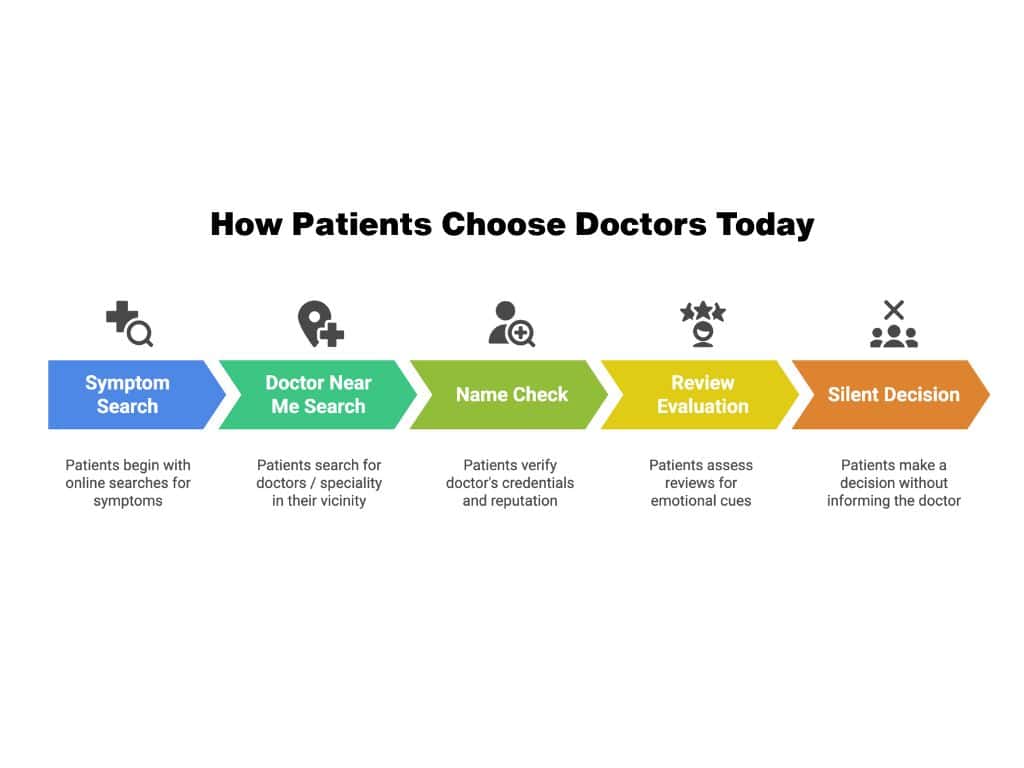
Step 4: Reviews Carry Emotional Weight
Patients don’t read reviews like doctors do.
They don’t evaluate clinical accuracy.
They look for emotional cues:
- Was the doctor patient?
- Did someone feel heard?
- Was the process smooth?
A few honest reviews can outweigh degrees and designations in a patient’s mind. Fair or not, that’s reality.
Step 5: The Silent Decision
Here’s the key point.
Patients don’t inform you that they considered you and chose someone else.
They just don’t show up.
What this really means is:
- Digital presence influences decisions quietly
- Good doctors lose patients invisibly
- Marketing isn’t creating demand, it’s removing friction
Doctors who understand this stop seeing digital marketing as self-promotion and start seeing it as patient guidance before the visit.
Perfect. This section needs honesty more than persuasion.
Section 4: Common Misconceptions Doctors Have About Digital Marketing
Most doctors don’t reject digital marketing because they’re old-fashioned or unaware.
They reject it because what they’ve seen looks uncomfortable, unethical, or unnecessary.
Let’s address the common thoughts openly.
Misconception 1: “If I’m a good doctor, patients will automatically come”
Clinical skill is non-negotiable.
But skill alone doesn’t guarantee visibility anymore.
A patient cannot choose a doctor they cannot find.
What’s changed is not the value of being good.
What’s changed is how patients discover that goodness.
Digital marketing doesn’t replace competence.
It helps patients reach competent doctors instead of stopping at whoever appeared first.
Misconception 2: “Marketing means advertising, discounts, and self-promotion”
This is where many doctors mentally switch off.
Healthcare marketing isn’t about offers or shouting louder than others.
Done right, it looks more like:
- Explaining conditions in simple language
- Showing what kind of cases you handle
- Making your clinic easy to understand and approach
If your OPD conversation is ethical, your digital communication should feel the same.
No gimmicks. No pressure.
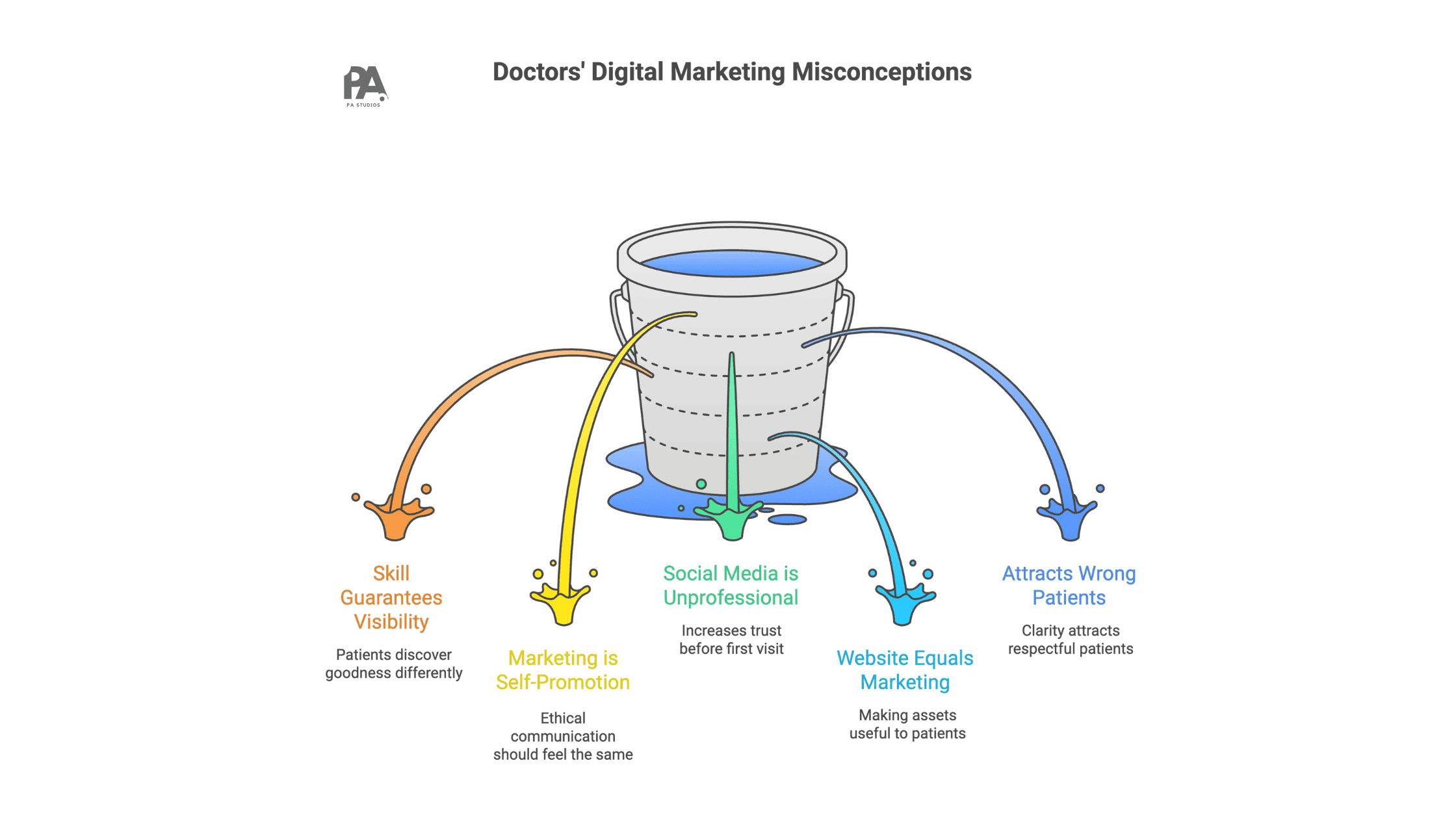
Misconception 3: “Social media is for influencers, not doctors”
This one is partly true and partly misunderstood.
Doctors don’t need to behave like influencers.
But patients do spend time on platforms like Instagram and YouTube looking for:
- Reassurance
- Basic explanations
- Familiarity
Educational content doesn’t reduce professionalism.
In many cases, it increases trust before the first visit.
Silence doesn’t preserve dignity.
It often creates distance.
Misconception 4: “I already have a website, so digital marketing is done”
A website is like a clinic building.
Having one doesn’t mean patients will walk in.
If:
- It doesn’t answer patient questions
- It doesn’t appear in searches
- It isn’t updated or visible locally
Then it’s just an online brochure.
Digital marketing is not about having assets.
It’s about making them useful to patients.
Misconception 5: “Digital marketing attracts the wrong kind of patients”
This fear is valid.
Aggressive advertising attracts bargain seekers.
Educational marketing attracts informed patients.
The kind of patients you attract depends on how you communicate, not whether you’re online.
Doctors who lead with clarity and boundaries usually attract patients who respect both.
The Real Issue Beneath These Misconceptions
Most doctors aren’t against digital marketing.
They’re against:
- Loss of control
- Misrepresentation
- Looking unprofessional
These concerns are real. They’re also solvable.
That’s why digital marketing for doctors must be handled differently than other industries. Strategy matters more than volume. Intent matters more than reach.
This is where experienced healthcare-focused teams, like PA Studios, usually step in quietly, not to push doctors online, but to help them communicate responsibly.
This is where things stop feeling vague and start feeling manageable.
Section 5: Core Pillars of Digital Marketing for Doctors
Digital marketing isn’t a hundred different activities.
For doctors, it rests on a few clear pillars.
When these are done right, everything else becomes optional.
5.1 Google Presence: Where Most Patient Journeys Begin
For most doctors in India, Google is the front door of the clinic.
Patients see:
- Your name
- Your clinic location
- Timings
- Photos
- Reviews
Often before they ever call.
This presence is made up of two things:
- A basic website that explains who you are and what you treat
- A Google Business Profile that helps patients find you locally
If either is missing or poorly maintained, patients assume:
- The clinic is inactive
- The doctor is not easily approachable
- Or worse, that information may not be reliable
Local visibility doesn’t require fancy design.
It requires accuracy, consistency, and care.
5.2 Content That Educates, Not Sells
This is the most misunderstood pillar.
Content for doctors is not marketing copy.
It’s an extension of the OPD conversation.
Patients want answers to questions like:
- What does this symptom usually mean?
- When should I worry?
- What are the treatment options?
- What happens if I delay care?
When doctors answer these calmly online:
- Anxiety reduces
- Trust increases
- Consultations become more focused
Good content doesn’t convince patients to come.
It helps the right patients decide.
This can take the form of:
- Simple blog articles
- FAQs on the website
- Short educational videos
No drama. No exaggeration. Just clarity.
5.3 Social Media for Doctors (Used the Right Way)
Social media is optional, but powerful when used correctly.
Doctors don’t need to post daily.
They don’t need trending audio.
They don’t need personal branding theatrics.
What works:
- Explaining common conditions
- Clarifying myths
- Talking about when to consult a doctor
- Setting expectations for treatment
Patients follow doctors online for familiarity, not entertainment.
When a patient already feels like they “know” you, walking into your clinic feels easier.
5.4 Online Reputation and Reviews
Reviews influence patients more than most doctors realize.
Patients don’t expect perfection.
They look for patterns.
They notice:
- How you speak
- Whether staff is helpful
- Whether concerns are listened to
Ethical reputation building means:
- Encouraging genuine feedback
- Responding politely when possible
- Never manipulating or fabricating reviews
A small number of honest reviews can outweigh a large marketing budget.
How These Pillars Work Together
Here’s the important part.
These pillars are not independent.
- Google brings visibility
- Content builds trust
- Social media builds familiarity
- Reviews provide reassurance
When aligned, patients arrive informed, confident, and ready for consultation.
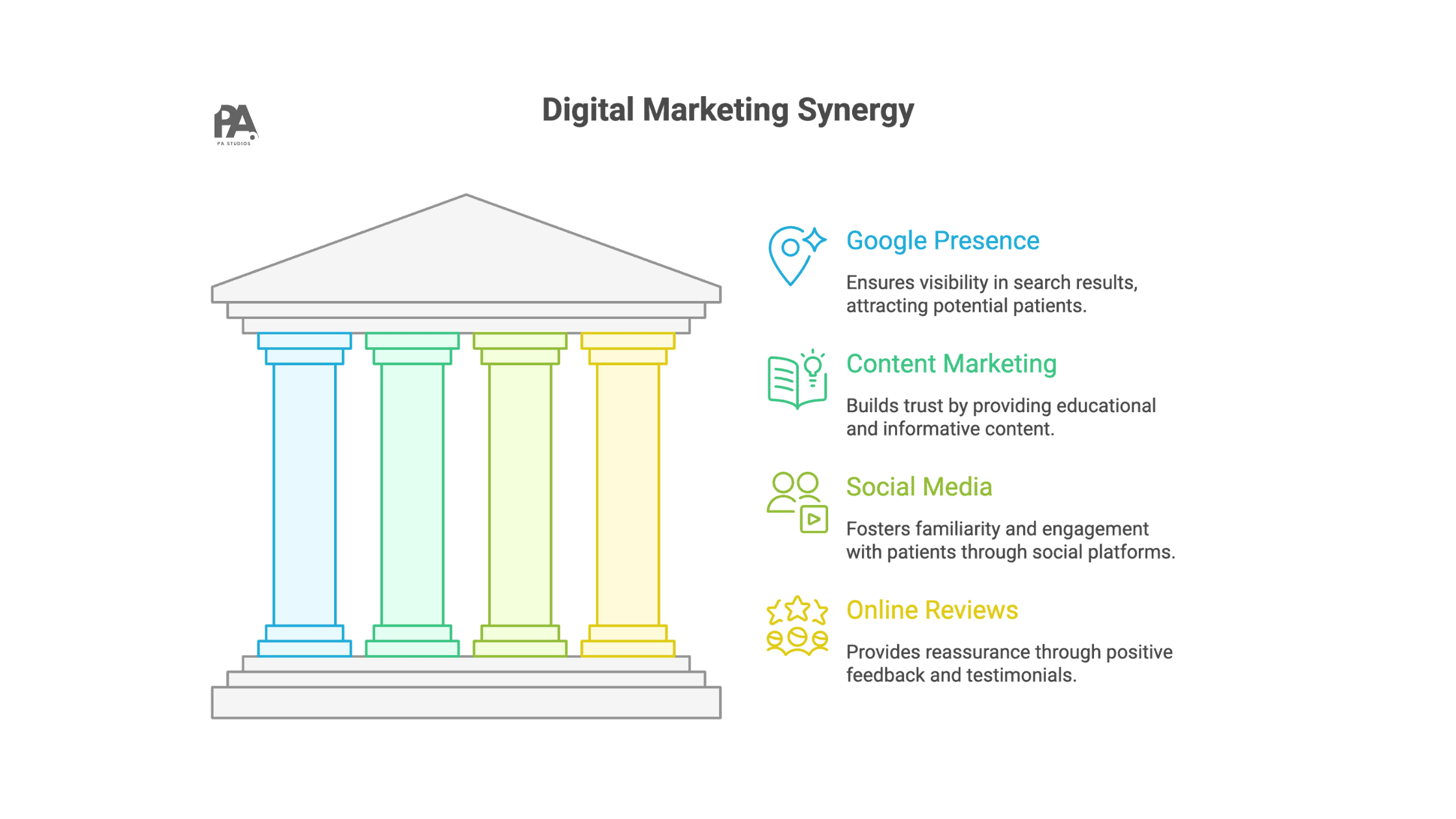
This is why digital marketing for doctors works best as a system, not as random posts or one-time efforts. It’s also why healthcare-focused teams like PA Studios usually start with structure first, not tactics.
This is the turning point of the article. Let’s slow it down and make it practical.
Section 6: How Digital Marketing Helps Doctors Get the Right Patients
Most doctors don’t want more patients.
They want:
- Patients who come at the right time
- Patients who understand their condition
- Patients who trust the process
- Patients who don’t need convincing at every step
Digital marketing, when done properly, quietly filters for exactly this.
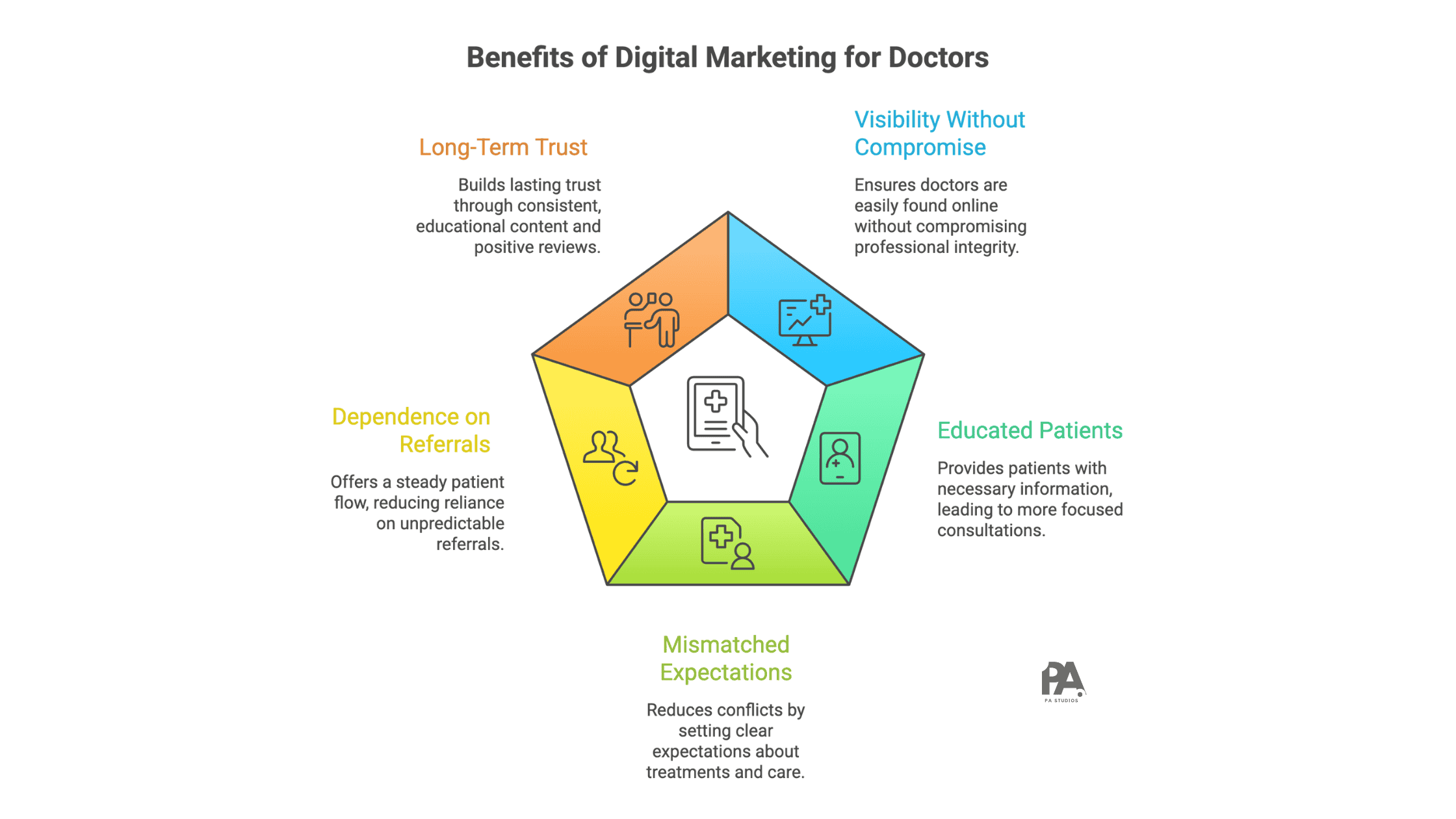
1. Visibility Without Compromise
Digital presence ensures that when someone genuinely needs your expertise, they can find you.
This doesn’t mean showing up for every search.
It means appearing for relevant searches:
- Your specialty
- Your location
- The conditions you commonly treat
This kind of visibility respects your boundaries and your time.
2. Educated Patients, Better Consultations
When patients read or watch your content before visiting:
- Basic doubts are already answered
- Fear is reduced
- Consultations become more focused
Instead of starting from zero, you begin at understanding.
Doctors often notice this shift subconsciously:
“Patients seem more prepared these days.”
That’s not an accident.
3. Fewer Mismatched Expectations
Many OPD conflicts come from misunderstanding:
- “I thought this would be quick”
- “I didn’t expect this treatment”
- “I didn’t know this would take time”
Clear digital communication sets expectations early.
When patients know:
- What you treat
- What you don’t
- How you generally approach care
They self-select appropriately.
4. Reduced Dependence on Referrals Alone
Referrals are valuable. They always will be.
But depending only on referrals creates unpredictability:
- Seasonal drops
- Sudden gaps
- Over-reliance on a few sources
Digital presence provides a steady baseline.
Not aggressive growth, just consistency.
5. Long-Term Trust That Compounds
Ads stop working the moment you stop paying.
Trust doesn’t.
Educational content, reviews, and clarity continue working quietly in the background. Over time, patients begin to associate your name with a particular problem or approach.
That’s not branding in a flashy sense.
That’s professional recall.
What Digital Marketing for Doctors Is Really Doing
Here’s the simplest way to look at it.
Digital marketing doesn’t push patients into your clinic.
It removes hesitation from patients who already need help.
That’s why it works best for doctors who are clear about their values and patient care.
Teams like PA Studios tend to focus here not on chasing numbers, but on shaping the patient journey before the OPD begins.
Next, we should address a practical question doctors often ask at this point:
Section 7: Digital Marketing Approach for Doctors
Once doctors understand why digital marketing matters, the next question is obvious:
“What kind of digital marketing actually works for my practice?”
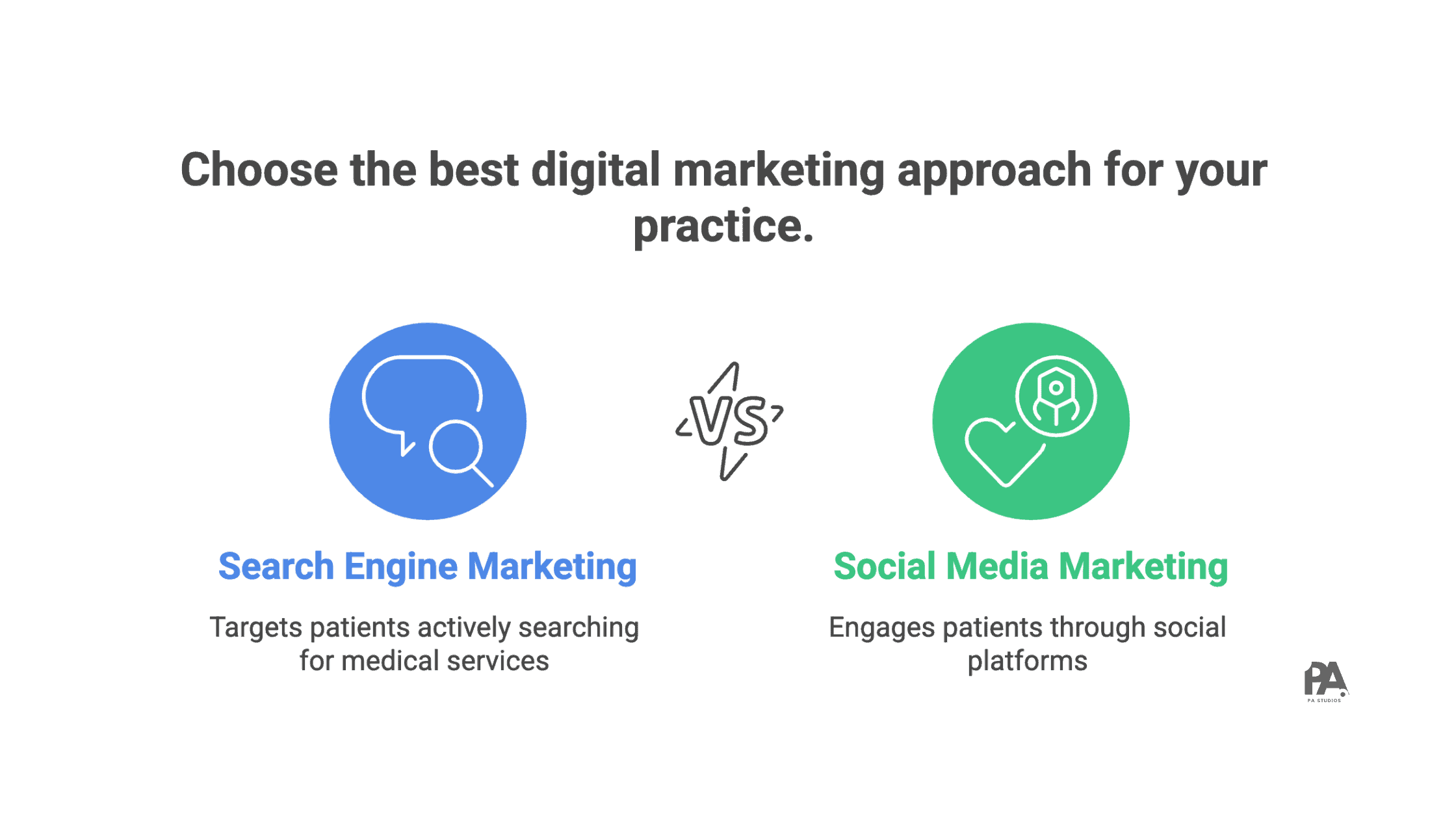
Broadly speaking, digital marketing for doctors falls into two main approaches:
- Search Engine Marketing
- Social Media Marketing
Both work.
But they work very differently, and not equally in every city.
Let’s break this down clearly.
1. Search Engine Marketing (Google & YouTube)
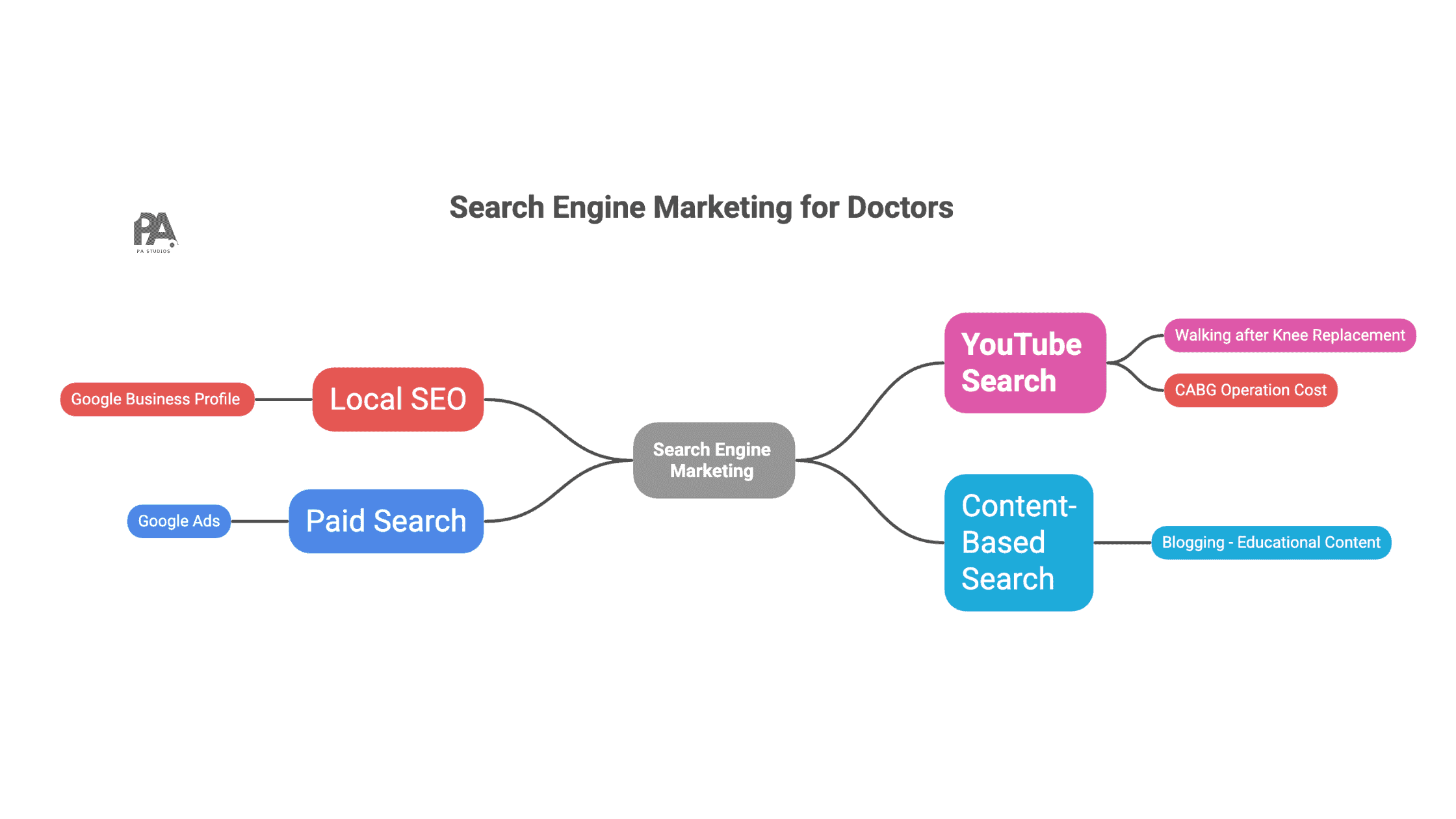
Search engine marketing is about being present when patients actively search for a problem, a symptom, or a specialist.
This includes:
- Google Search results
- Google Maps
- YouTube search
Typical patient searches look like:
- “Chest pain causes”
- “Cardiologist near me”
- “Best orthopedic doctor for knee pain”
Here, the patient already has intent.
They’re not browsing. They’re looking for help.
Why Search Engine Marketing Works Best in Tier 1 Cities
Search-based marketing depends heavily on search volume.
In Tier 1 cities like:
- Hyderabad
- Chennai
- Bengaluru
- Mumbai
- Delhi
Internet penetration is high.
Patients are more likely to:
- Google symptoms
- Compare specialists
- Read before choosing
For example:
- “Cardiologist near me” in Mumbai or Hyderabad may get 400–600 searches per month
- Ranking or advertising for such a keyword can realistically bring consistent traffic
Now compare this with a Tier 3 city.
In cities like Guntur or similar towns:
- The same keyword may show very low or even zero search volume
- Even if everything is done correctly, demand itself may be limited
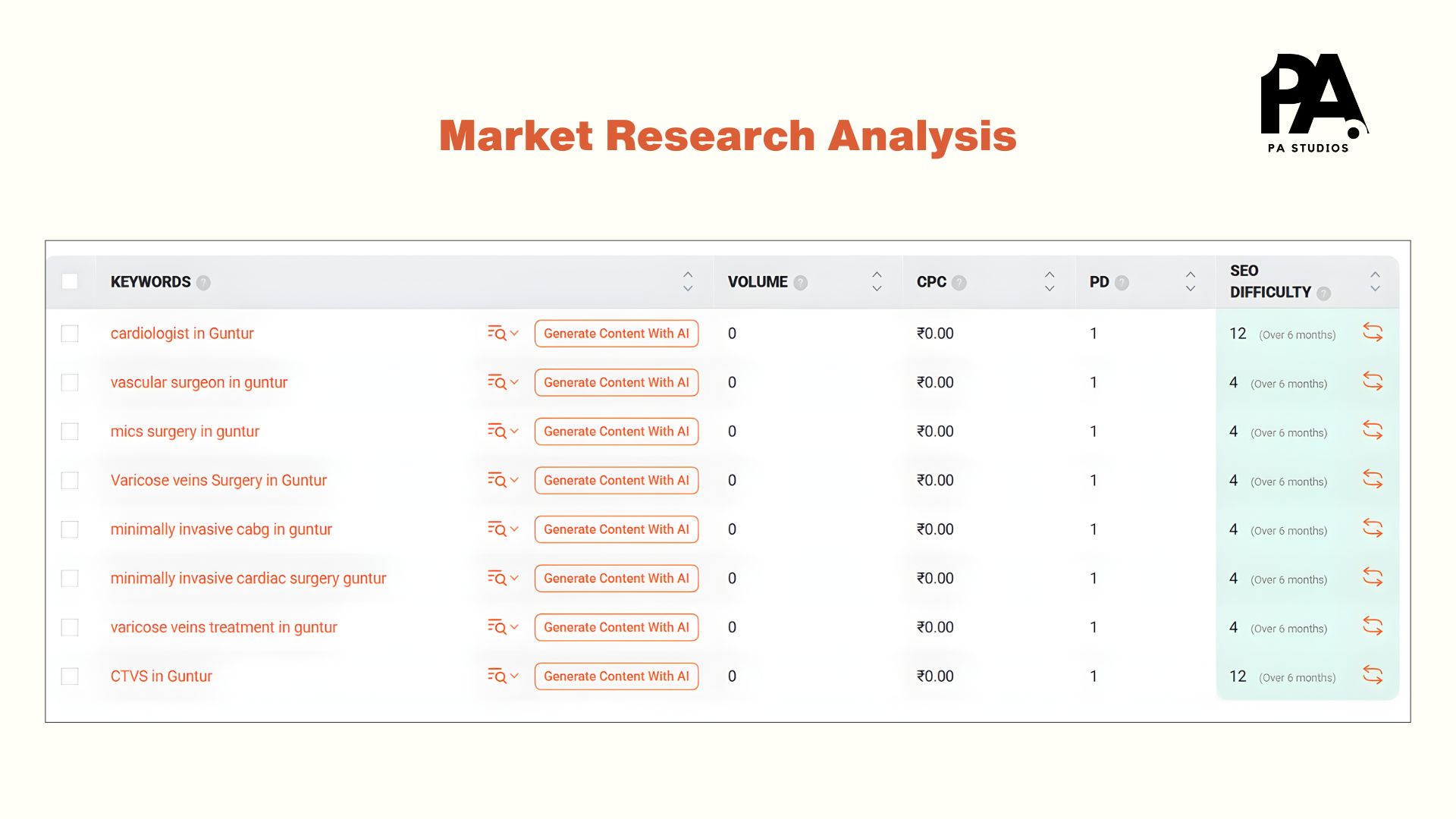
This doesn’t mean the doctor is not good.
It simply means patients are not searching that way yet.
That’s why search engine marketing is naturally more effective in Tier 1 cities, with exceptions depending on specialty and local behavior.
A Critical Step Before Investing in Search Marketing
Before spending time or money on search engine marketing, doctors should always ask for:
A basic keyword analysis.
This helps answer:
- Are patients searching for my specialty in this city?
- What terms are they actually using?
- Is there enough demand to justify the effort?
Skipping this step often leads to frustration, not results.
Paid Search vs Content-Based Search Marketing
Search engine marketing itself has two layers.
1. Paid Search Engine Marketing (Google Ads)
This involves running ads for specific keywords like:
- “General physician near me”
- “Varicose vein surgeon in Hyderabad”
You pay to appear when someone searches.
This works well when:
- Search volume is present
- The intent is strong
- Geography supports it
2. Content-Based Search (Blogging & Educational Content)
Here, doctors create content around patient questions, such as:
- Causes of chest pain
- Symptoms of heart attack
- Knee pain treatment options
- Differences between surgical procedures
This builds long-term visibility and trust.
But even here, what you write should depend on keyword analysis, not guesswork.
2. Social Media Marketing (Instagram, YouTube, LinkedIn)
Social media marketing works on a completely different principle.
Here, patients are not searching.
They are scrolling.
This makes social media especially useful for:
- New practitioners
- Doctors in Tier 2 and Tier 3 cities
- Practices where search demand is low
Why Social Media Works Across All City Types
Smartphone usage has exploded across India.
Even in Tier 3 cities and rural areas:
- Patients watch YouTube videos
- Families scroll Instagram
- Health content is consumed passively
Unlike Google search, social media does not depend on search volume.
That’s why it works even when:
- “Doctor near me” searches are low
- Patients are not actively Googling symptoms
The key difference across cities is language.
- Tier 1 cities → English works well
- Tier 2 & Tier 3 cities → Local language builds faster trust
Organic vs Paid Social Media Marketing
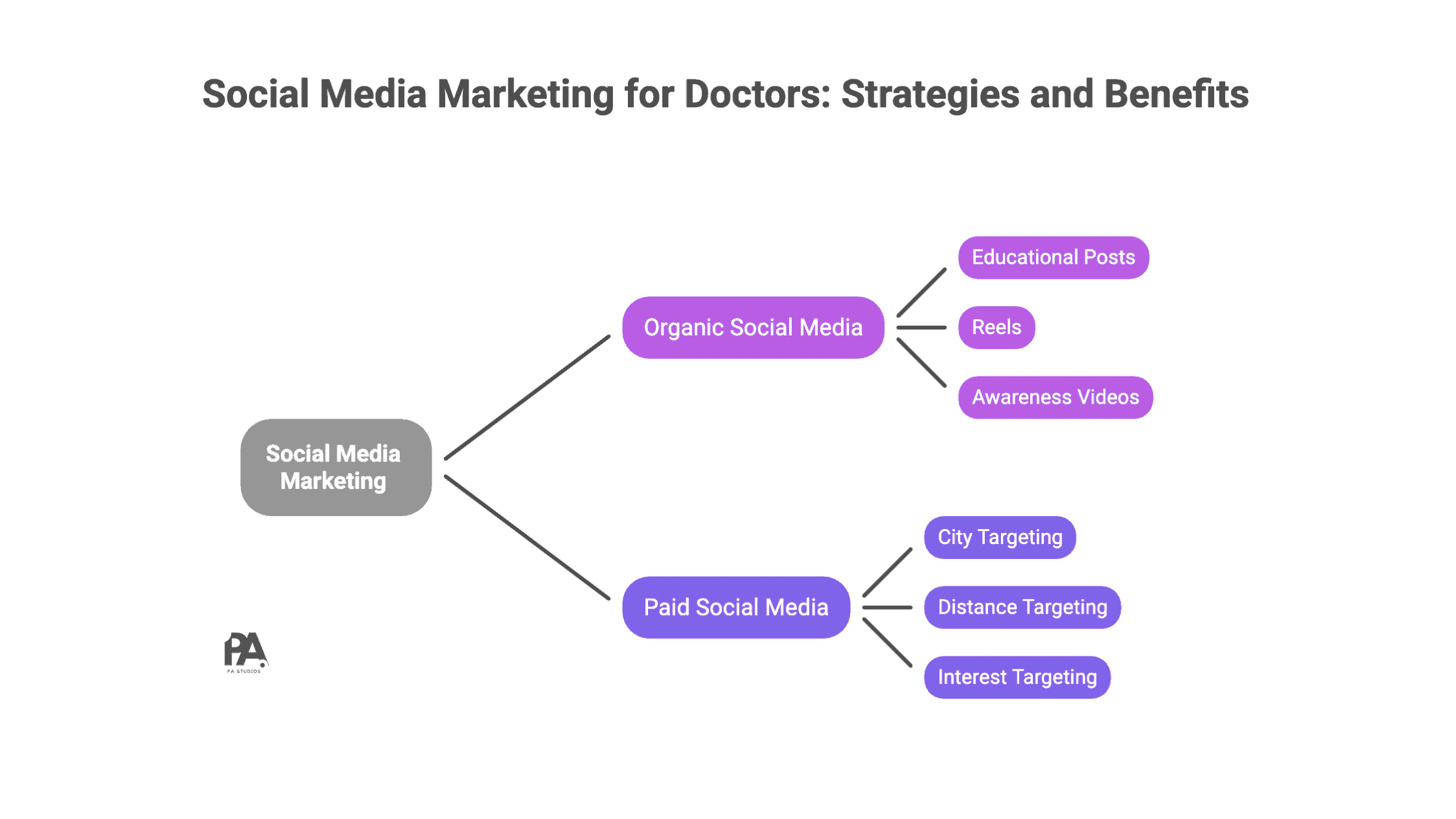
Social media marketing also has two clear divisions.
1. Organic Social Media (Content Marketing)
This includes:
- Educational posts
- Reels explaining conditions
- Short awareness videos
It’s called “organic” because:
- Platforms control who sees the content
- Doctors have limited control over reach
This builds trust slowly but steadily.
2. Paid Social Media (Meta Ads)
Here, doctors have much more control.
You can:
- Show ads only in a specific city
- Target people within 10–15 km of your clinic
- Focus on interests and age groups
Paid social media is especially useful when:
- You want local awareness
- You’re a new clinic
- Search demand is limited
Choosing the Right Approach Matters More Than Doing Everything
The biggest mistake doctors make is trying all platforms at once.
The smarter approach is:
- Understand your city
- Understand patient behavior
- Choose the channel that matches reality
This is why healthcare-focused teams like PA Studios usually start with analysis first, not execution. The goal is not presence everywhere, but presence where it actually makes sense.
Let’s Compare Organic vs Paid Digital Marketing for Doctors
| Aspect | Paid Marketing | Organic Marketing |
|---|---|---|
| What it means | You pay platforms to show your content or ads | You earn visibility naturally over time |
| Common platforms | Google Ads, Meta Ads (Instagram/Facebook), YouTube Ads | Google search results, blogs, Instagram posts, YouTube videos |
| Speed of results | Fast. Visibility starts as soon as ads go live | Slow. Builds gradually over weeks and months |
| Patient intent | High when targeting search keywords | Mixed. Awareness first, intent later |
| Control over targeting | Very high (location, age, interests, radius) | Very limited (platform decides reach) |
| Dependence on budget | High. Stops when spending stops | Low. Continues even without spending |
| Best use case | New clinics, launches, quick visibility | Long-term trust and authority |
| Cost predictability | Predictable but recurring | Time-heavy, money-light |
| Trust building | Moderate. Patients know it’s an ad | High. Feels educational, not promotional |
| Content requirement | Short, direct, problem-focused | Educational, consistent, patient-centric |
| Risk if done poorly | Wasted spend, wrong patient type | Slow growth, low initial motivation |
| Longevity of impact | Short-term | Long-term and compounding |
Section 8: What Digital Marketing for Doctors Cannot Do (A Necessary Reality Check)
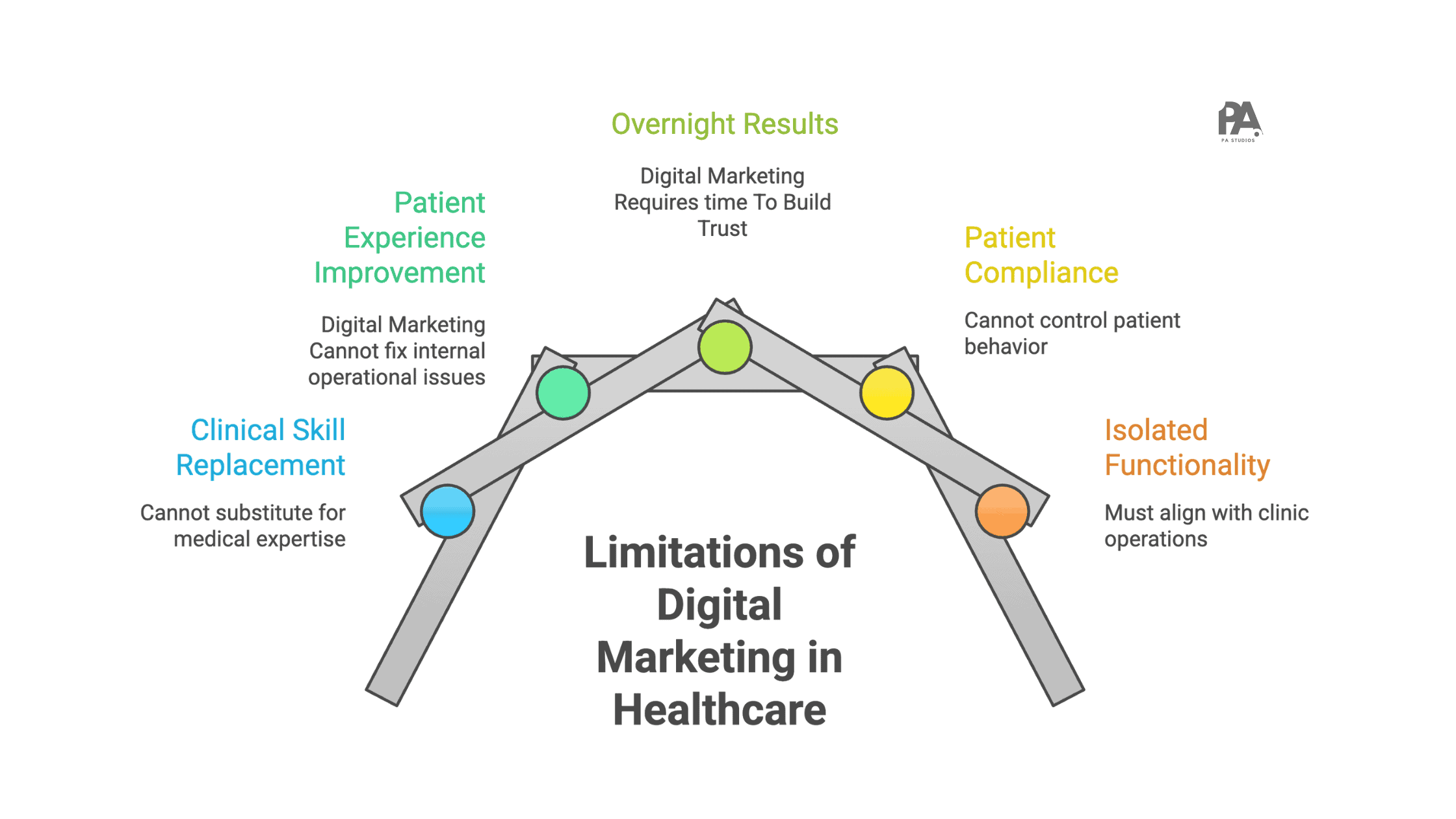
Digital marketing is powerful, but it is not magic.
When expectations are unrealistic, doctors feel disappointed, and marketing feels dishonest. So let’s be clear about what digital marketing cannot do for a medical practice.
1. It Cannot Replace Clinical Skill or Experience
No amount of online presence can compensate for:
- Poor diagnosis
- Rushed consultations
- Inconsistent care
Patients may visit once because of visibility.
They return only because of competence.
Digital marketing can open the door.
Your practice determines whether it stays open.
2. It Cannot Fix a Broken Patient Experience
If patients face:
- Long unexplained waiting times
- Unhelpful staff
- Confusing processes
No online strategy can permanently cover that.
In fact, digital visibility sometimes amplifies problems faster. Reviews reflect reality, not intention.
This is why ethical marketing starts with internal alignment.
3. It Cannot Deliver Overnight Results
Healthcare trust grows slowly.
- Content takes time to be discovered
- Reviews accumulate gradually
- Patient confidence builds step by step
Anyone promising instant results in healthcare is either inexperienced or careless.
Digital marketing in medicine is more like chronic disease management than emergency treatment. Consistency matters more than intensity.
4. It Cannot Guarantee Patient Compliance or Outcomes
Doctors often hear:
“I read this online…”
Digital content can guide, not control.
Patients will still:
- Delay visits
- Seek second opinions
- Make emotional decisions
Digital marketing doesn’t eliminate human behavior.
It simply improves understanding when patients choose to engage.
5. It Cannot Work in Isolation
Marketing cannot function separately from:
- Clinic operations
- Communication style
- Ethical standards
When disconnected, it feels artificial.
When aligned, it feels natural.
Why This Reality Check Matters
Doctors value honesty.
Knowing what digital marketing for doctors cannot do protects you from:
- False promises
- Misaligned agencies
- Wasted effort
This is why experienced healthcare partners like PA Studios tend to be conservative in projections and careful in execution. In healthcare, restraint builds more trust than exaggeration.
This is where we help doctors make a grounded decision, not an emotional one.
Section 9: DIY vs Hiring a Healthcare Digital Marketing Agency
Many doctors ask a simple question:
“Can I do this myself, or do I really need an agency?”
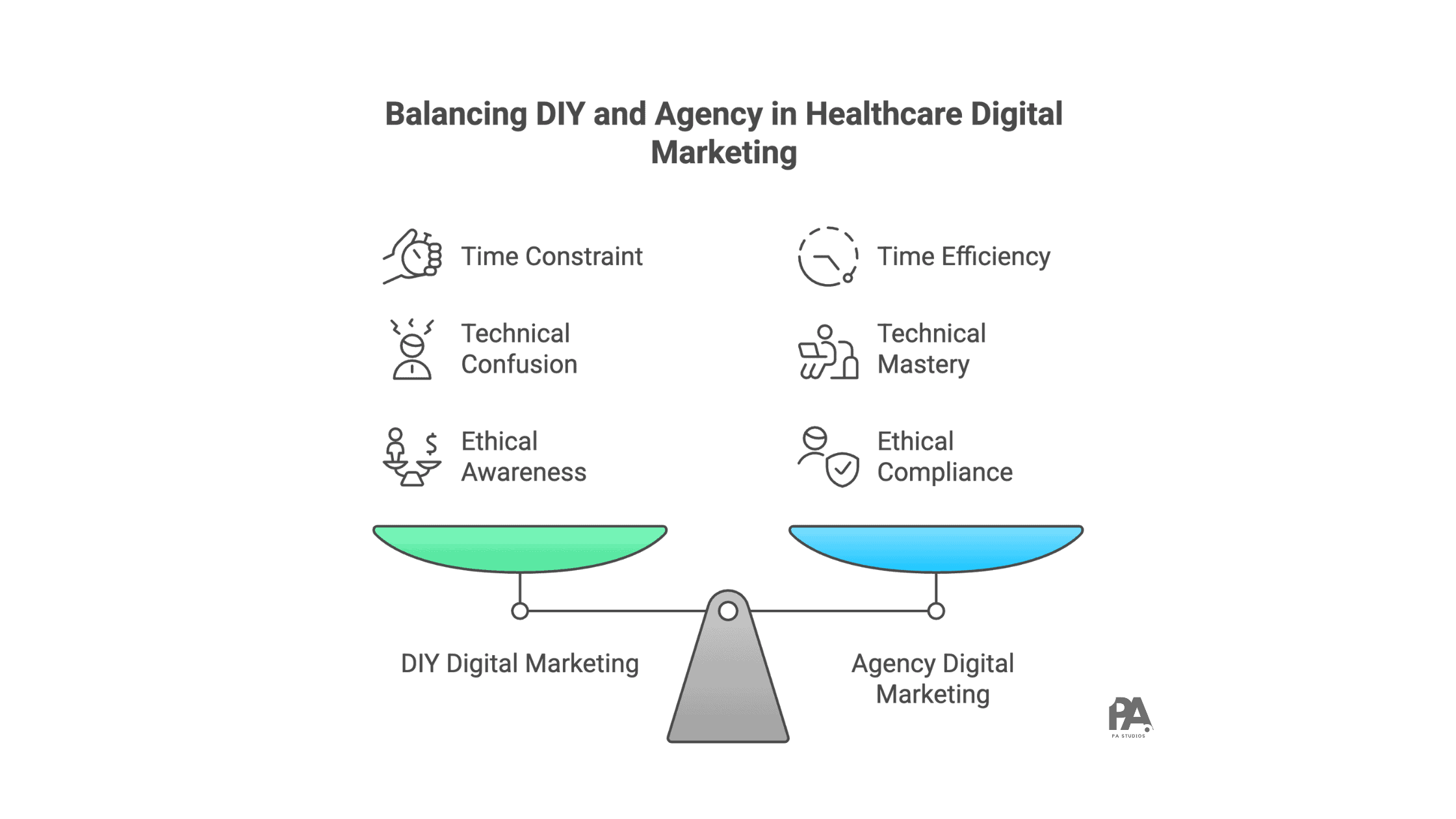
The honest answer is: some parts yes, some parts no.
Let’s separate them clearly.
What Doctors Can Reasonably Do on Their Own
Most doctors can manage the basics if they have clarity and time.
This includes:
- Keeping clinic details accurate online
- Posting occasional educational updates
- Responding politely to reviews
- Sharing health awareness messages
For doctors who enjoy communication, this can even feel rewarding.
But time is the real constraint.
Consistency is harder than it looks.
Where DIY Usually Breaks Down
Digital marketing isn’t just about posting.
It involves:
- Understanding patient search behavior
- Structuring content so it gets discovered
- Managing local visibility technically
- Tracking what works and what doesn’t
Doctors often start with good intent and stop due to:
- Lack of time
- Unclear results
- Technical confusion
That’s not failure. That’s reality.
What a Healthcare-Focused Agency Actually Does
A good healthcare digital marketing agency for doctors doesn’t “run ads and post reels.”
It should:
- Understand patient psychology
- Respect medical ethics
- Build systems, not noise
- Translate clinical expertise into patient-friendly language
The difference lies in context.
Agencies that work with restaurants or real estate often struggle in healthcare. The tone, responsibility, and consequences are different.
This is where specialized teams like PA Studios usually fit in, not by taking control away from doctors, but by handling the structure so doctors can focus on care.
Red Flags When Choosing an Agency
Doctors should be cautious if an agency:
- Promises guaranteed patient numbers
- Pushes fear-based advertising
- Avoids discussing ethics
- Talks more about platforms than patients
Good Digital Marketing agencies for doctors ask questions first.
Bad ones sell first.
A Balanced Way to Look at It
Digital marketing works best when:
- Doctors remain the voice
- Agencies handle the system
- Ethics guide every decision
Remember, it’s a partnership, not just a delegation.
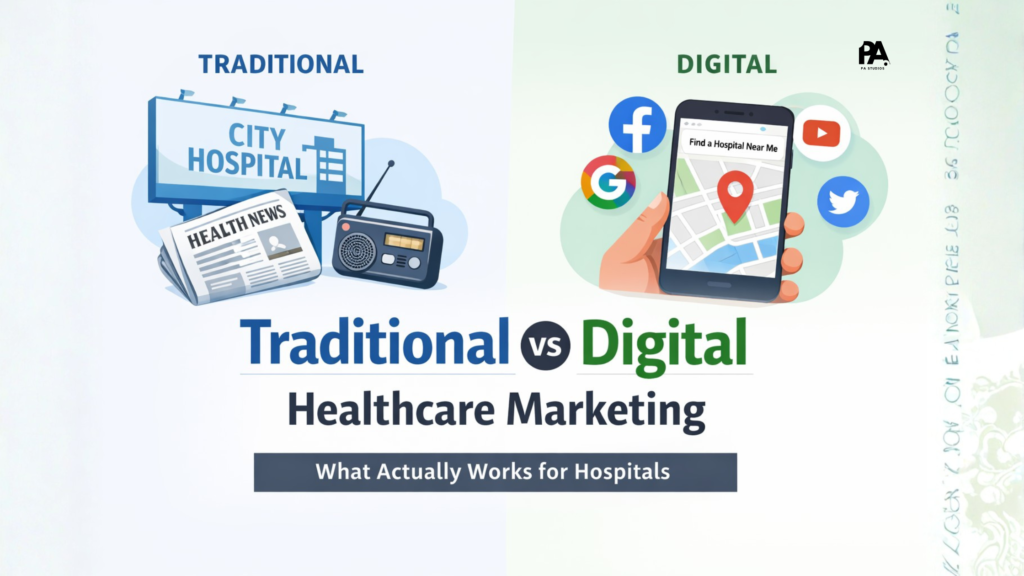
We have written a in-depth comparison using real world examples on Traditional vs Digital Healthcare Marketing, do check it out.
Section 10: How to Start Digital Marketing for Your Practice (A Simple, Practical Path)
If you’re wondering where to begin, this is the sequence that works for most doctors. Not because it’s trendy, but because it follows how patients actually think and search.
Step 1: Set Up Your Google Business Profile (GMB)
This is non-negotiable.
For many clinics in India, Google Maps is the first and last place a patient looks.
Your Google Business Profile should clearly show:
- Clinic name and location
- Consultation timings
- Phone number
- Real photos of the clinic
When this is missing or inaccurate, patients don’t wait. They move on.
Think of GMB as your digital clinic board outside the building.
Step 2: Set Up a Professional Website
A website is not for marketing.
It’s for reassurance.
A good medical website does three things:
- Introduces you clearly
- Explains what kind of patients you help
- Makes it easy to contact or book
No heavy design. No long claims.
Just calm, readable explanations.
Patients should feel, “This doctor sounds clear and trustworthy.”
Step 3: Create a Dedicated Professional Instagram Account
This is optional, but powerful when used correctly.
Instagram works well in India because:
- Patients already spend time there
- Short explanations are easy to consume
- Familiarity builds before the visit
This should be a professional account, not personal.
The goal is not popularity.
The goal is familiarity.
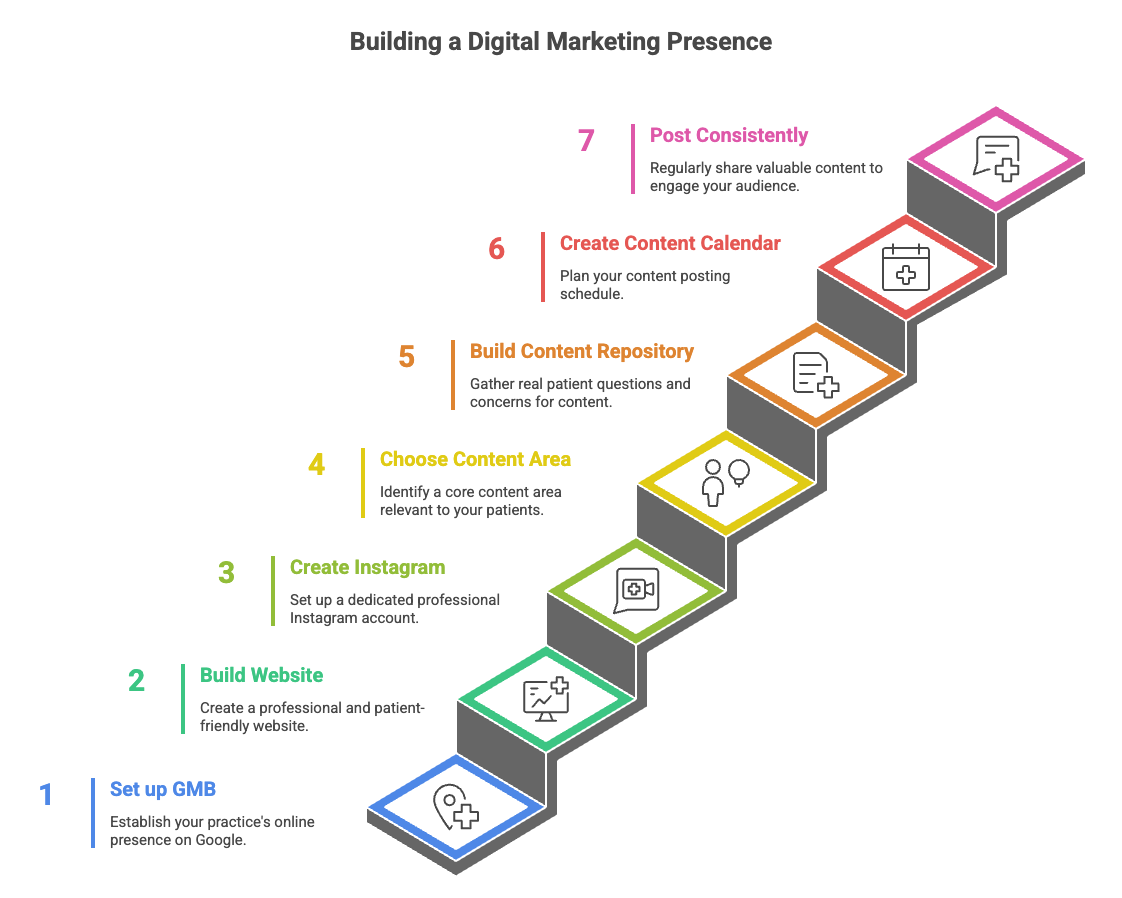
Step 4: Pick One Core Content Area Your Patients Care About
Don’t talk about everything.
Pick one area your patients commonly visit you for.
For example:
- Orthopedician → Knee pain
- ENT → Hearing loss
- Cardiologist → Chest pain or BP
- General physician → Fever and lifestyle diseases
This creates clarity, both for patients and for you.
Step 5: Build a Content Repository From Patient Reality
Good content doesn’t come from imagination.
It comes from the OPD.
Build topics around:
- Patient doubts
- Common fears
- Wrong assumptions
- Delay-related risks
- Treatment expectations
Think in terms of:
- Needs
- Pain points
- Confusion
- Emotional reassurance
This is where healthcare digital marketing for doctors – focused teams like PA Studios usually add the most value, by translating everyday OPD conversations into structured content.
Step 6: Create a Simple Content Calendar
You don’t need complexity.
A basic calendar answers:
- What will I post?
- How often?
- On which platform?
Consistency matters more than frequency.
Even one good post a week builds momentum over time.
Step 7: Start Posting and Stay Consistent
This is the hardest step.
Not because it’s difficult, but because it requires patience.
Early on:
- Reach will be low
- Feedback will be minimal
- Results will feel invisible
That’s normal.
Digital trust builds quietly.
Weeks later, it shows up in the OPD.
One Important Reminder
You don’t need to do all this alone.
Some doctors enjoy this process.
Others prefer to focus only on patients.
Both are valid.
What matters is that your digital presence reflects the same clarity, ethics, and care that patients experience inside your clinic.
Let’s close this the right way. Calm, grounded, and respectful of the profession.
Conclusion : Digital Marketing as an Extension of Your OPD
Digital marketing works best for doctors when it stops feeling like marketing.
At its core, it’s simply your OPD continuing outside clinic hours.
Patients come with questions, fears, and confusion.
Inside the clinic, you address them in person.
Online, you address them in advance.
Nothing about this is artificial.
A clear digital presence:
- Reduces patient anxiety before the visit
- Improves the quality of consultations
- Helps the right patients find the right doctor
It doesn’t change who you are as a clinician.
It just ensures patients meet you before they meet your reception desk.
Doctors who approach digital marketing with this mindset rarely feel uncomfortable. There’s no pressure to impress, compete, or perform. The focus stays where it belongs: patient understanding and trust.
Over time, this trust compounds. Not loudly, not instantly, but steadily.
This is why healthcare digital marketing, when done responsibly, feels less like promotion and more like service. And why teams like PA Studios quietly work behind the scenes, helping doctors structure their digital presence without compromising ethics or authenticity.
If there’s one thing to remember, it’s this:
Patients haven’t changed their need for good doctors.
They’ve only changed how they look for them.
And meeting them there, calmly and honestly, is not marketing.
It’s care.
Pingback: Traditional vs Digital Healthcare Marketing: A Practical Comparison for Hospitals